
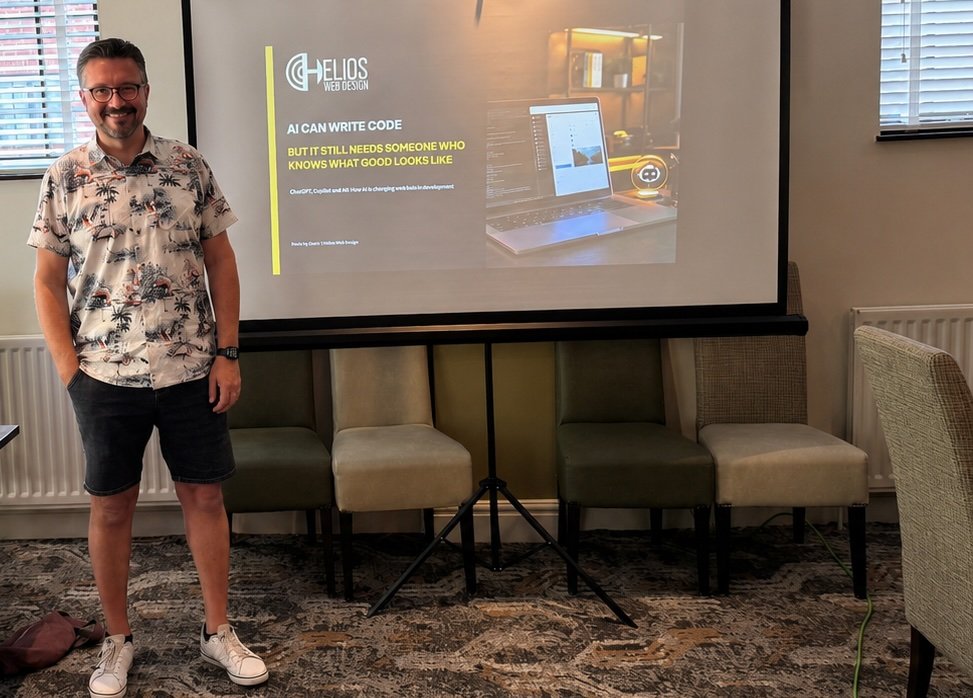
AI Can Write Code, But It Still Needs Someone Who Knows What Good Looks Like
This week’s 10-minute presentation at BNSL was delivered by Martin Ingram of Helios Web Design, who spoke about how artificial intelligence is already changing the way websites are planned, written, improved and maintained.
Martin’s presentation, titled “ChatGPT, Codex and Me: How AI is Changing Website Development”, focused on the practical reality of using AI in day-to-day web design work. Rather than presenting AI as a magic button or a threat to every job, Martin explained that tools such as ChatGPT and Codex are best understood as very fast assistants. They can be extremely useful, but only when guided by experience, judgement and a clear understanding of what the client actually needs.
A key point throughout the presentation was that the better the brief, the better the result. AI can help with content ideas, blog outlines, page headings, FAQ sections, meta descriptions and SEO structure, but it does not automatically understand a business, its customers, its tone of voice or what makes it trustworthy. That information still has to come from proper conversations, business knowledge and human judgement.
Martin explained how he uses ChatGPT to move from a blank page to a workable first structure. It can help turn rough ideas into useful articles, suggest SEO angles, improve unclear copy and identify when a page is trying to say too much at once. However, he stressed that AI-generated copy should never simply be copied and pasted. It needs to be edited, checked and shaped so that it sounds like the business and does the job the page is there to do.
He also spoke about Codex, which is more useful for the technical workshop side of website development. This can include code fixes, layout changes, WordPress tweaks, CSS checks and repetitive tasks across multiple pages. For example, if a spacing improvement has been made on one location page, Codex can help apply the same change to similar pages without altering the content. Used properly, this can save time on careful, repetitive work.
For small businesses, this matters because websites need to keep improving after launch. AI can help make some improvements quicker and more affordable, from clearer service pages and stronger calls to action to better SEO, mobile improvements, fresh content and ongoing support. The value is not in replacing the service, but in helping more of the client’s budget go into strategy, quality checks and meaningful improvements.
Martin was also clear about the risks. AI can sound confident even when it is wrong. It can write about services a business does not offer, suggest changes that technically work but visually feel wrong, or produce content that contains keywords but does not build trust with a real customer. It does not properly understand the client’s reputation, ideal customer, brand personality, margins or long-term aims unless those things are carefully explained and reviewed.
The central message of the presentation was that the human layer still matters. A good website still needs a brief, a strategy, a build process, proper checking and ongoing improvement. AI can support several of those stages, but it is not accountable for the result. Experience is still needed to decide what is useful, what is accurate and what will actually work for the business.
Martin also introduced the idea of Jevons Paradox, using it to explain why AI may not simply remove work. When something becomes more efficient and cheaper to use, demand for it can sometimes increase rather than decrease. In website development, if SEO research, page planning, content updates and small technical fixes become more efficient, more businesses may be able to afford improvements that previously sat on the “one day” list.
He then compared this with the introduction of ATMs. While many people expected cash machines to replace bank tellers completely, the result was more complicated. ATMs reduced the need for routine cash handling, but bank branches became cheaper to operate and tellers’ roles shifted towards customer service, advice and relationship banking. Martin suggested that AI may have a similar effect in many areas: some tasks will change, but judgement, relationship-building and knowing what good work looks like will become even more important.
The practical takeaway for business owners was simple: use AI to start, not to finish. It is excellent for ideas, first drafts and structure, but it needs real business information, careful checking and proper editing. Website content still needs to be accurate, clear, trustworthy and focused on what the visitor should do next.
Martin finished by explaining that Helios Web Design is looking to help businesses whose websites are live, but not working hard enough. That might mean a site is outdated, unclear, weak on SEO, difficult to update or missing useful functionality. Helios helps improve those websites using modern tools where they are helpful, but always with human judgement, experience and a practical business focus.
Thank you to Martin Ingram of Helios Web Design for an interesting and thought-provoking presentation on the role of AI in website development.
Helios Web Design
WordPress website design, support and internet marketing
Email: enquiries@helioswebdesign.co.uk
Telephone: 07811 012513

