
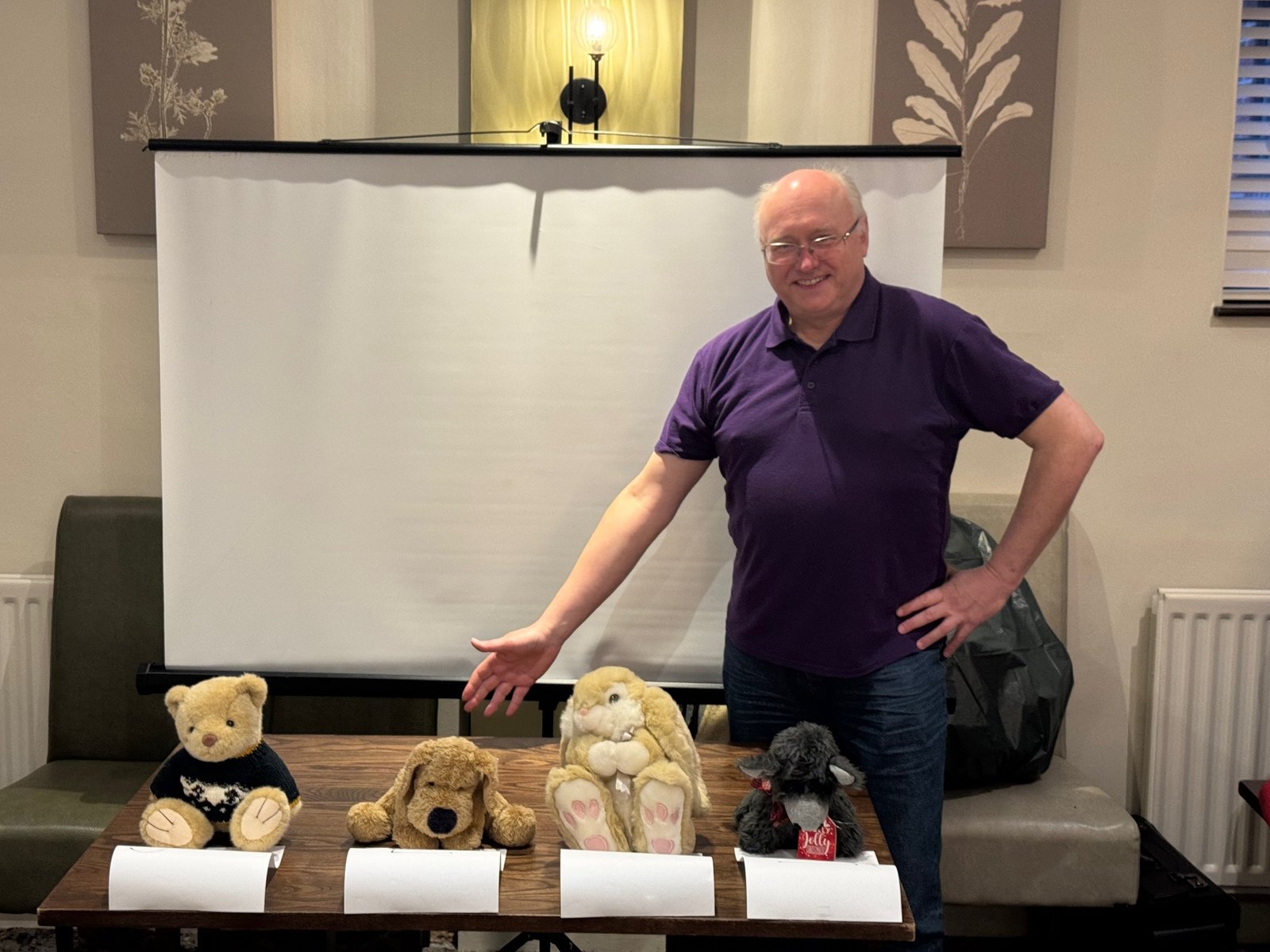
At our recent Business Networking South Leicestershire (BNSL) meeting, we were treated to one of the most entertaining and memorable 10-minute presentations we’ve seen — delivered by Simon Goodman of Beyond Beige IT Support.
Rather than using slides or technical jargon, Simon quite literally performed his presentation, using a collection of cuddly toys to race across the table. The toys were labelled 2, 5, 6 and 7 — representing different Wi-Fi generations and frequency bands — and competed in short and long races, with and without obstacles.
It was funny, engaging, and — most importantly — it made a complex technical subject instantly understandable.
Wi-Fi Explained… Using Cuddly Toys
Simon’s analogy was simple but brilliant:
- Short races vs long races represented distance
- Obstacles represented walls, floors, interference and congestion
- Different toys represented different Wi-Fi standards and frequency bands
Through this, Simon explained that not all Wi-Fi is the same — and that choosing the wrong setup can lead to poor performance, dropped connections and frustration, especially in busy homes or business environments.
Understanding Wi-Fi Bands: Strengths & Weaknesses
Simon clearly broke down the most common Wi-Fi generations and bands:
2.4 GHz (Wi-Fi 4)
- Long range
- Better at passing through walls and obstacles
- Slower speeds
- More interference (shared with many household devices)
Best for: Older devices, smart home equipment, long distances.
5 GHz (Wi-Fi 5)
- Faster speeds
- Less interference than 2.4 GHz
- Shorter range
- Struggles more with walls and floors
Best for: Laptops, streaming, offices with open spaces.
6 GHz (Wi-Fi 6E)
- Even faster speeds
- Very low interference
- Shortest range
- Requires compatible devices
Best for: High-performance environments with newer hardware.
So… What’s New with Wi-Fi 7?
Simon then moved on to explain Wi-Fi 7 — the latest generation — and why it’s such a significant step forward.
Key Features of Wi-Fi 7
- Multi-Link Operation (MLO)
Devices can connect across multiple bands at the same time (2.4 GHz, 5 GHz and 6 GHz), automatically choosing the fastest and most reliable path. - Wider Channels (up to 320 MHz)
This dramatically increases throughput, allowing much higher data rates. - Lower Latency
Ideal for video calls, gaming, VoIP and real-time cloud applications. - Better Handling of Congestion
Wi-Fi 7 manages busy environments far more effectively, even with many devices connected. - Improved Reliability
If one band becomes congested or unstable, traffic is instantly rerouted.
In Simon’s analogy, Wi-Fi 7 wasn’t just faster — it was smarter. The cuddly toy didn’t just run one race; it could switch tracks mid-race to avoid obstacles and still win.
Choosing the Right Wi-Fi for the Environment
One of Simon’s key messages was that the “best” Wi-Fi depends entirely on where and how it’s used.
Homes, offices, warehouses and shared workspaces all have different needs — and simply buying the latest router without understanding the environment often leads to disappointment.
This is where Simon’s experience comes in: assessing the space, understanding usage, and designing a solution that actually works.
Why the Presentation Worked So Well
- Complex ideas made simple
- No jargon or sales pressure
- Memorable visuals and humour
- Clear, practical takeaways
It was a great example of how technical expertise doesn’t need to be dry — and how understanding technology properly can save time, money and frustration.
Final Thoughts
Thank you to Simon for delivering a truly original and educational presentation. The cuddly toys may have raised a few eyebrows, but everyone left the room with a far better understanding of Wi-Fi — especially how and why Wi-Fi 7 is such a game changer.
If your business or home network struggles with speed, reliability or coverage, Simon’s the person who can explain why — and fix it properly.
Come and Visit BNSL
If you’d like to meet knowledgeable professionals like Simon and experience presentations like this first-hand, why not come along to a BNSL meeting as a guest?
— The BNSL Committee

