
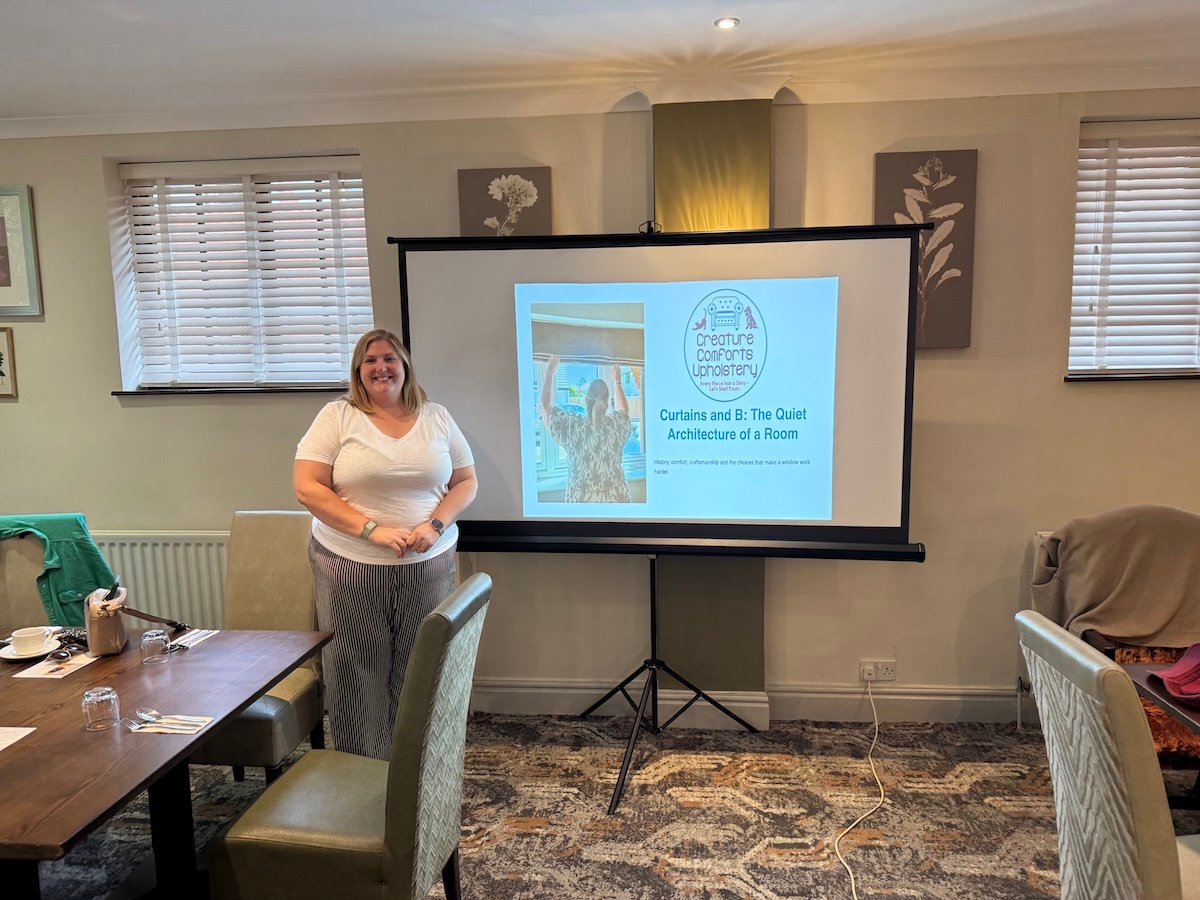
At our latest Business Networking South Leicestershire meeting, Helen Davis of Creature Comforts Upholstery gave members a fascinating insight into something most of us probably take for granted – curtains.
Helen’s presentation, “Curtains: The Quiet Architecture of a Room”, explored the history of curtains, their practical role within our homes and workplaces, and why choosing the right fabric, lining, heading and construction can make a significant difference to how a room looks, feels and performs.
Find out more about Creature Comforts Upholstery:
https://www.creaturecomfortsupholstery.co.uk/
Curtains Have Been Around Longer Than You Might Think
Helen began with a little history.
Curtains are certainly not a modern invention. Evidence from ancient settlements including Pompeii and Herculaneum shows that fabrics were being used as room dividers and doorway coverings thousands of years ago.
Over the centuries, their role has evolved considerably. What began as a practical way of controlling draughts and dividing spaces developed into a sophisticated combination of privacy, light control, temperature management and interior design.
Today’s best curtain schemes still combine those two fundamental purposes – performance and appearance.
Curtains Can Help Control the Temperature of a Room
One of the most interesting parts of Helen’s presentation was the role curtains can play in temperature control.
Windows can be one of the weakest points in a building’s thermal envelope. A well-fitted, properly lined curtain creates an additional layer between the room and the glass.
During colder weather, lined and close-fitting curtains can help reduce draughts and make a room feel warmer.
During warmer weather, closing curtains at the appropriate time and choosing suitable fabrics can help reduce glare and unwanted solar gain.
So curtains aren’t simply something attractive to hang either side of a window – properly specified, they can contribute to making a room considerably more comfortable.
Controlling Light and Privacy
Helen also explained how different fabrics and curtain combinations can completely change the way natural light behaves within a room.
Sheer fabrics can soften daylight while retaining brightness and providing an element of privacy.
Dim-out and blackout fabrics can be used where greater control is required, making them particularly useful for bedrooms, presentation rooms, home cinemas and spaces containing screens.
Layering different window treatments can provide even greater flexibility, allowing a room to move from bright morning daylight through to greater privacy and intimacy in the evening.
The key is understanding how the room will actually be used before deciding what should go at the window.
The Heading Determines the Hang
Helen then introduced us to something many of us probably hadn’t given much thought to before – curtain headings.
The heading is the part at the top of the curtain that determines how the fabric hangs, moves, stacks and frames the window.
Different options include:
- Pencil Pleat – a versatile option suitable for poles or tracks.
- Eyelet – a clean, contemporary appearance designed for use with a curtain pole.
- Pinch Pleat – a more structured and tailored finish, particularly suited to formal interiors.
- Wave – modern, regular folds providing a neat stack-back and requiring a specialist track or tracked pole.
The choice doesn’t simply affect appearance. It can influence how much of the window is covered when the curtains are open, the amount of fabric required, how effectively light is controlled and the type of hardware needed.
Choose the Heading Before Choosing the Fabric
Perhaps one of the most useful pieces of advice from Helen’s presentation was to avoid starting with the fabric simply because you like its colour or pattern.
Instead, start by asking what the window needs to achieve.
Does the room feel cold?
Is there too much sunlight or glare?
Is privacy important?
Does the curtain need to provide blackout?
How frequently will the curtains be opened and closed?
How much space is available either side of the window for the curtains to stack back?
Once those questions have been answered, the heading, lining, hardware and fabric can all be selected to work together.
It’s a much more considered approach than simply finding a fabric you like and hoping everything else works around it.
Why Handmade Curtains Are Different
Helen also explained why bespoke, handmade curtains can provide a very different result from an off-the-shelf alternative.
Every window is different. With handmade curtains, the proportions, fullness, lining, interlining, hem depth and heading can all be tailored specifically to the window and the room.
Attention can also be given to details such as pattern matching, balanced hems and carefully trained folds.
The result is something designed to fit the space rather than asking the space to accommodate a standard-sized product.
Quality construction also means that bespoke curtains can be a long-term investment, with components that can often be altered or repaired rather than simply replacing the entire window treatment.
More Than Decoration
Helen’s presentation ultimately challenged us to think about curtains differently.
Rather than treating them as the final decorative addition to a room, they can be considered part of the room’s architecture.
The right curtain scheme can help a space feel:
- Warmer
- Calmer
- More private
- Better lit
- More comfortable
- More visually balanced
Helen’s advice was simple: define the problem first, then specify the solution.
By considering the fabric, lining, heading, hardware and way the room is used as a complete system, you end up with curtains that perform as well as they look.
Need Bespoke Curtains or Upholstery?
If you’re considering new curtains, blinds, soft furnishings or giving a favourite piece of furniture a new lease of life, Helen and the team at Creature Comforts Upholstery can help.
With bespoke work, the details matter – from choosing the right fabric to ensuring the finished piece works perfectly within your home.
Find out more about Creature Comforts Upholstery:
https://www.creaturecomfortsupholstery.co.uk/
Come Along to BNSL
Helen’s presentation was another great example of the expertise that exists within the BNSL room.
Every week we learn something new about our members’ businesses, while building trusted relationships in a friendly and relaxed environment.
If you’d like to grow your network, meet experienced local business owners and see what BNSL is all about, why not come along as a guest?
Contact the BNSL Committee:
https://businessnetworkingleicestershire.co.uk/contact-us/
Local. Supportive. Affordable. Real.
— The BNSL Committee

